
Mastering the Creative in E-Commerce

by Gaya Shachar
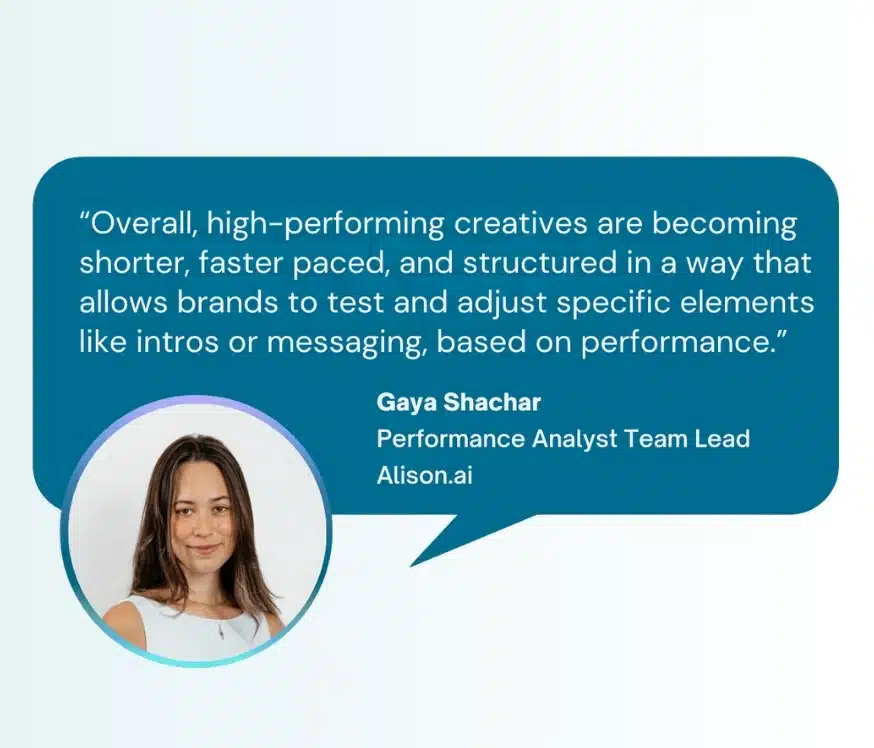
In the ever-competitive world of e-commerce, creative can make or break campaign performance. Gaya Shachar, Performance Analyst Team Lead at Alison.ai, is uncovering how brands can stay ahead of ad fatigue, tap into what’s working in 2025, and prepare for the future of AI-driven creative.
Cracking the Code on Ad Fatigue
Ad fatigue remains one of the toughest challenges in e-commerce marketing. Based on Alison.ai’s analysis of millions of impressions, the earliest signals of creative fatigue include:
- Falling CTR
- Rising frequency
- Increasing CPC or CPA
- Dropping engagement (comments, shares, reactions)
When these metrics shift, it’s usually a sign that audiences are tuning out. The solution isn’t to scrap your best-performing ad altogether; it’s to refresh with intent. Preserve the elements that made the ad successful (messaging, product showcase, visual hook), while layering in subtle variations such as a new intro scene, a tweaked CTA, or even a fresh voiceover. The key is balancing data-backed optimization with creative nuance.
The Creative Elements That Work in 2025
So what’s driving engagement and conversions right now? Alison.ai’s findings point to a clear set of trends:
- Authentic, native content: User-generated videos with casual voiceovers and natural camera angles consistently outperform polished studio shoots.
- Problem-solution storytelling: “Before and after” formats and in-action product demos quickly communicate value.
- Bold CTAs: Benefit-driven phrases like “Try it risk-free” outperform generic CTAs, especially when introduced early.
- Text on screen: Crucial for silent autoplay environments.
- Human faces: Ads that open with eye contact draw attention faster in crowded feeds.
The winning formula? Shorter, faster-paced ads that can be easily tested, iterated, and adapted.
Creative Localization with AI
E-commerce is global, and what works in one region often falls flat in another. Alison.ai’s AI-driven creative tagging makes it easier to spot cultural nuances and adapt accordingly:
- North America: Direct-response, fast-paced creatives with clear problem-solution hooks perform best.
- India & SEA: Emotionally rich storytelling, family-focused scenes, and culturally resonant colors or music dominate during major shopping holidays.
- Cultural details: Red may signal urgency in the West but celebration in Asia; captions in local languages lift engagement across SEA markets.
With AI surfacing these patterns, brands can scale localized iterations without losing brand consistency.
Creative Best Practices for Mobile OEM Advertising
OEM ad formats, like push notifications, native banners, and app store placements, blend into trusted device environments and are often perceived more as recommendations than ads. To succeed:
- Keep messaging short, benefit-first, and value-driven.
- Avoid loud, promotional copy; align with native UI design.
- Use clean, minimal visuals with clear icons or thumbnails.
- Personalize around context (e.g., app behavior, setup moments).
Here, subtlety builds trust, and trust drives action.
AI as the Bridge Across Fragmented Devices
Designing for dozens of Android OEMs means dealing with different screen sizes, overlays, and UI quirks. AI is transforming this process by:
- Highlighting safe zones for layouts across notches, punch-holes, and foldables.
- Automating resizing and reflowing of creative assets.
- Surfacing device-specific performance insights (e.g., AMOLED vs LCD).
- Providing virtual previews to catch misalignments pre-launch.
This allows creative teams to maintain consistency while scaling efficiently across fragmented ecosystems.
Looking Ahead: Generative AI in 2026
The next frontier? Generative AI tightly integrated with creative analytics. Brands will soon be able to:
- Generate multiple ad variations – formats, languages, placements, in minutes.
- Apply historical performance data to every iteration.
- Maintain a closed feedback loop where AI learns and improves with each launch.
Seasonal campaigns, regional launches, and high-volume creative needs will shift from heavy manual work to fast, performance-informed generation at scale.
Final Word
In 2025 and beyond, creative isn’t just part of the campaign, it is the optimization. By combining human creativity with AI-driven insights, brands can outpace fatigue, resonate across cultures, and scale smarter.
Related Articles

Elevate Your eCommerce Marketing: Achieve Success with AI
Have you considered the possibility of using AI to get through to customers in the oversaturated marketing landscape? It’s well…

Don’t Let Ad Fatigue Drain Your Performance
Every second your ads are live, they’re fighting for attention in the busiest scroll of someone’s day. And attention? It’s…