Home » Blog » AI Tools to Help Boost Your Marketing Strategy
What would your marketing look like if you had more clarity, more speed, and more room to experiment? AI is not a magic fix, but it is becoming a powerful part of the process. It helps teams move faster, test smarter, and work with insight instead of guesswork.
Marketing today comes with pressure. More content, more channels, more expectations. AI tools are stepping in to meet that demand. They write, design, analyze, and personalize at scale. Some focus on creative. Some focus on language. Others help with data or automation. Each one solves a different problem.
This article looks at four tools changing how marketers work. Together, they show how AI can support better thinking, stronger execution, and more confident decisions.
Google Veo: Elevating Video Ad Creation with Generative AI
Video is one of the most powerful formats in marketing. It captures attention, tells stories fast, and drives engagement across channels. But great video takes time, resources, and creative skill. Google Veo changes that equation. It uses generative AI to turn simple inputs into full video ads. Marketers can enter a short prompt, an image, or some basic brand details and receive a complete, high-quality video ready for deployment.
The results are fast, realistic, and incredibly polished. Veo does not just build visuals. It also adds sound, dialogue, and voiceover. It keeps scenes fluid and believable. The AI follows natural cues like lip movement and lighting. It even supports continuity between shots. Marketers do not need a studio or a large team. They can generate dozens of versions, tailor them for different platforms, and get them live within hours.
Veo fits directly into the Google Ads environment. The Asset Studio uses the same AI to reshape existing creative. Static images become animated videos. Landscape clips get transformed for mobile. Every asset can be adapted, tested, and improved on the spot.
Highlights:
Turns basic inputs into full video ads
Includes audio, voiceover, and smooth scene flow
Integrated into Google Ads for easy asset adaptation
Built for speed, scale, and creative freedom
Persado Essential Motivation: Emotional Intelligence for Marketing Copy
Words shape how people feel. They create urgency, inspire action, and build trust. Every subject line, caption, or headline has the power to connect or be ignored. But writing for emotion is hard. Many teams rely on instinct or experience. They write what sounds good, not what performs best. Persado Essential Motivation changes how marketers use language. It brings science to the art of copy.
Essential Motivation is trained on millions of real campaigns. It knows how language moves people. The platform tests tones, phrases, and emotional cues, then scores each option based on likely performance. Instead of guessing what will resonate, teams see clear signals. Urgency, joy, curiosity, confidence – each emotion is measured and matched to the message. The result is content that lands with the right impact.
Essential Motivation suggests variations, predicts outcomes, and learns from every result. It helps teams write faster and perform better. Tone stays on brand. Style stays consistent. Every word serves a purpose.
Highlights:
Built for emotional resonance in marketing language
Scores and ranks messages by predicted impact
Learns from campaign data to improve over time
Scales content creation without losing brand voice
Creative performance is often treated as a mystery. Teams launch ads, track results, and move on. They know what performed, but they rarely know why. Alison.ai helps close that gap. It turns creatives into something you can measure, learn from, and improve. Instead of relying on gut instinct, marketers can see what’s working down to the frame, the color, the word.
Alison.ai breaks down every visual and message element. It maps those elements to outcomes. Clicks, conversions, scroll rates, engagement. Each result connects back to a creative choice. The platform uses machine learning and computer vision to make sense of the chaos. It sees patterns most teams miss. A certain image might do well early in a campaign but fade later. A color scheme might lift click-throughs on one platform but fall flat on another.
It goes further with competitor analysis. Alison watches what others are running. It picks up trends. It identifies and detects creative elements and fatigue. It finds out which formats and styles are gaining traction. The tool then converts all this data into tangible insights and recommendations, and goes further to turn all that information into actionable Smart Briefs that allow advertisers to choose what they implement in their new creatives. Alison also assists teams with aligned storyboards and enables data-backed video generation as the final outcome. Designers get clear direction. Strategists get real answers.
Highlights:
Tracks performance by creative element
Surfaces trends from your ads and competitors
Recommends data-backed changes
Speeds up creative testing and iteration
Salesforce Einstein GPT: Personalized Marketing at Scale
Relevance drives results. The closer a message fits the person receiving it, the more likely it is to connect. Most teams know this, but delivering personalized content at scale is hard. Data sits in one place. Content lives in another. Einstein GPT brings those pieces together. It helps marketers write, analyze, and respond using the data they already have.
Einstein GPT works inside Salesforce. That means it sees every touchpoint. Purchase history, email engagement, browsing behavior, and more. When a marketer asks for help writing a message, the AI pulls context from that data. It suggests content that speaks to the person behind the screen. Product recommendations match past habits. Tone matches customer history. The result feels tailored, not generic.
It works across campaigns. Emails, landing pages, social posts. Teams can write faster, iterate more often, and adapt messages for different segments without starting from scratch. It also helps answer questions. Ask which ad worked best last quarter. Ask why one segment dropped off. The AI looks into the data and replies in plain language.
Highlights:
Built into Salesforce Marketing Cloud
Uses real customer data for content suggestions
Supports personalized content across channels
Helps with campaign analysis and performance breakdowns
AI Agents: Always-On Support for Scalable Marketing
As marketing grows more complex, the need for consistent execution and real-time responsiveness increases. AI agents are stepping into that space. These digital workers can handle tasks across campaigns, channels, and teams. Unlike traditional automation, AI agents respond to changing inputs with context-aware actions.
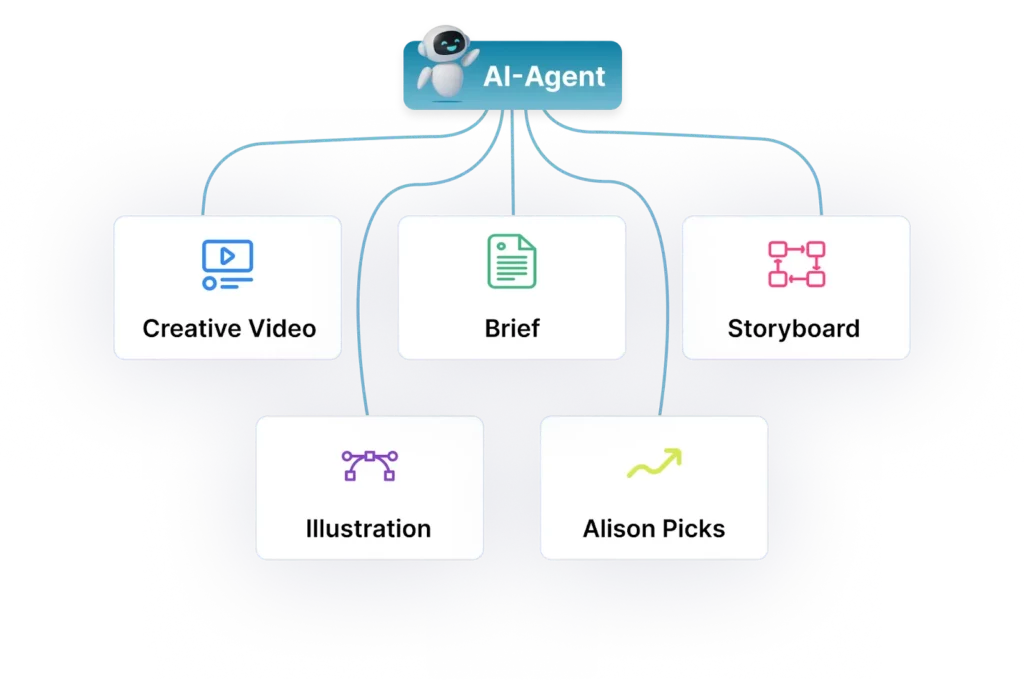
An AI agent can begin by retrieving and scanning network data to identify patterns and actionable insights. It can then manage diverse creative workflows, drafting briefs informed by brand goals and historical context. Based on the brief, it builds aligned storyboards. It generates visual assets such as illustrations or mockups and can also produce complete creative videos for multichannel deployment. Alongside this, the agent can offer prioritized suggestions based on performance signals and strategic goals.
This unified capability reduces back-and-forth between tools and teams. Instead of managing disconnected steps, marketers gain a coordinated partner that simplifies creation, ensures consistency, and accelerates iteration.
Highlights:
Generates marketing briefs from goals and insights
Produces storyboards and illustrations to guide design
Creates high-quality video content with minimal input
Offers prioritized creative suggestions for decision support
A Smarter Way to Build What’s Next
AI will not take the creativity out of marketing. It will challenge us to use it more intentionally. The teams that win will not be the ones who automate everything. They will be the ones who ask better questions, test sharper ideas, and stay close to what the data is really saying.
These tools are getting smarter. The opportunity is to get smarter with them. That is where the next wave of great marketing will come from.
The integration of Artificial Intelligence into online advertising is revolutionizing the ad industry by combining cutting-edge technology with human creativity. AI powers…
Alison.ai augments your workflow to accelerate content creation, boost performance, and fine-tune your creative strategy. Craft impactful creatives that captivate your audience and achieve your business objectives.