The World Cup Final Became a Super Bowl. Your Creative Playbook Didn’t.

Jul 20, 2026
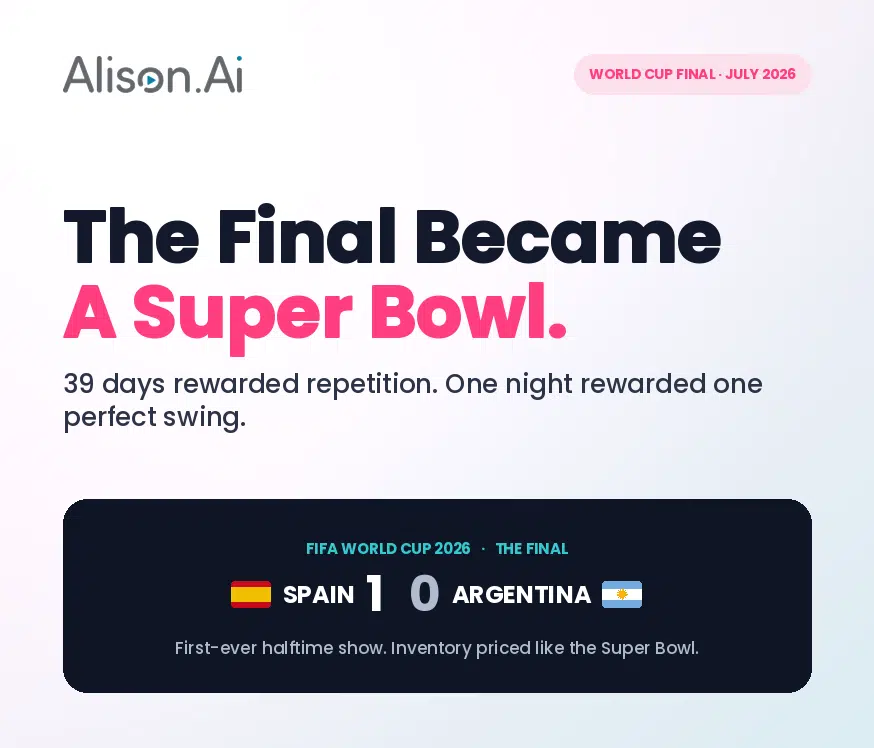
The 2026 World Cup final aired the first Super Bowl-style halftime show in the tournament’s history, and the ad inventory around it was priced to rival the Super Bowl itself. That single change flips the creative playbook. A 39-day tournament rewards repetition and slow-building story arcs. One night rewards a single perfect swing. Telling which kind of creative you are holding, before you spend, is exactly what Alison.ai’s Creative Genome was built to read.
For most of soccer’s history, the sport was an advertiser’s nightmare of scarcity. The clock never stops. The halves run uninterrupted. A live World Cup match gave brands almost nowhere to go except the pre-game show, halftime, and the final whistle. That shortage is the whole reason a single World Cup minute costs what it does.
Then 2026 rewrote the inventory. Hydration breaks dropped a fresh commercial window into the middle of every half, with 30-second spots reportedly running from around $200,000 in the group stage to as much as $1 million to $2 million in the knockout rounds. And the final went all the way: a first-ever halftime show produced by Coldplay’s Chris Martin, with a lineup reported to include Madonna, Shakira, Justin Bieber, and BTS, turning the last match of the tournament into full appointment-viewing spectacle.
The result is a new kind of moment. Roughly 1.5 billion people worldwide were expected to watch Spain beat Argentina, with tens of millions more in the United States alone. For reference, a 30-second Super Bowl spot recently went for about $7 million in front of roughly 123 million viewers. The World Cup final now plays in that same weight class, except it carries the entire planet with it.
Who showed up, and what it cost
Look at who bought into this tournament and the pattern is obvious: these were Super Bowl brands, spending at Super Bowl intensity. Michelob Ultra ran as the official beer sponsor with a rotation of spots. Adidas, a FIFA partner since 1970, opened with a star-packed short film, while Nike, which has never once been an official World Cup sponsor, muscled into the conversation anyway with a sprawling ambassador epic. Even He Gets Us, a fixture of recent Super Bowls, showed up. When the same advertisers treat both events as tentpoles, the World Cup final is not borrowing the Super Bowl’s format by accident.
The inventory was sold like the Super Bowl too. Fox carried the final in English, with Telemundo and Peacock in Spanish and Tubi streaming, and Fox spent the tournament selling hydration-break windows with 30-second spots reportedly ranging from around $200,000 early to $1 million to $2 million in the biggest matches. Analysts estimated Fox could pull $250 million to $600 million in World Cup ad sales overall, and for the final its US inventory was reported to rival or surpass Super Bowl pricing, where a 30-second spot recently ran about $7 million.
Attention followed the money, which is the part that should interest any performance marketer. iSpot clocked World Cup ads on Fox at an attention index of 121, meaning 21 percent above the norm. Individual brands ran well past that: Home Depot landed 36 percent above average, Nike 35 percent, Wells Fargo 34 percent. A captive audience that does not leave the room is worth more per second, and the final was the most captive audience of the year.
Exposure: the official Nielsen count for the final is still being finalized, but Fox’s president of insights and analytics projected it would average around 46 million US viewers, which would rank it among the most-watched soccer telecasts in the country’s history. For scale, FIFA projected roughly 1.5 billion viewers worldwide for the final, the US-Belgium round-of-16 match alone drew 50.1 million combined across Fox, Telemundo, and Peacock, and Fox Sports said 84 million Americans watched at least some of the tournament. Whatever the final Nielsen line reads, this was the largest shared screen of the year.
And this audience was not just large, it was emotionally invested in a way a normal broadcast never gets. The final was widely billed as Lionel Messi’s World Cup farewell, and the pull was measurable long before kickoff. His tournament debut alone drew 9.1 million US viewers on Fox, Argentina’s semifinal against England set a Spanish-language record on Telemundo and Peacock, and pre-match ticket resale prices and social volume both ran past semifinal levels. People did not tune in for a product demo. They tuned in for a moment they knew would not come again, and Argentina losing 1-0 did nothing to blunt it. For a brand, that is the rarest attention there is: an audience that showed up on purpose, feeling something, once.
Here is the problem that creates.
Marathon creative and one-shot creative are not the same job
A 39-day tournament is a marathon. The creative logic is stamina and sequencing. You rotate variations so audiences do not tune out, you manage fatigue as the same viewers see you again and again, and you have room to let a story build across weeks. Best of all, mistakes are survivable. A hook that flopped in the group stage can be quietly retired by the quarterfinals.
A single-moment spectacle is a sprint, and it behaves more like a penalty kick than a season. You get one swing. There is no next week to fix this week. The creative that wins is one idea at full force, timed to a cultural moment that will not come again. Spain needed 120 minutes, ten heroic Emiliano Martinez saves, a red card, and a substitute named Ferran Torres to finally break Argentina in the 106th minute. Any brand that bought into that window had the same margin for error the players did. None.
And people were watching closely. Across the tournament, iSpot measured World Cup ads on Fox pulling attention roughly 21 percent above the norm, because a captive final-whistle audience does not wander off the way it does during a regular broadcast. High attention is a gift and a trap. When everyone is actually looking, mediocre creative does not slip by unnoticed. It gets noticed for being mediocre.
Why this is Alison.ai’s territory
Here is the uncomfortable part. You cannot A/B test a one-shot moment. The moment is the test. By the time a postmortem tells you the spot underperformed, the seven-figure buy is already spent and the audience has gone home.
That is the exact gap Alison.ai closes. Marathon creative and sprint creative have different DNA, and our Creative Genome reads it before the spot ever airs. Preflight Plus scores a piece of creative against the job you are actually asking it to do, so you know whether you are holding something built to grind out a long campaign or something built to land one unrepeatable swing. You find out while you can still change it, not after.
Because the difference is not cosmetic. Marathon creative leans on recognition and repetition, the slow drip that pays off over dozens of exposures. One-shot creative has to earn everything in a few seconds, from a standing start, in front of the largest shared audience on earth. Score it for the wrong race and you lose, no matter how good it looked in the deck.
See You in Four Years. Your Next One-Shot Won’t Wait.
The 2026 final showed where premium attention is heading. The rare, unmissable, single-screen moment is becoming the most valuable inventory there is, and the World Cup final just joined the Super Bowl at the top of that list. That is a massive opportunity, and it came with a catch that plenty of brands learned the hard way on Sunday night.
The playbook that carried you through 39 days is not the playbook that wins one night. Knowing which one your creative is built for, before the whistle, is the whole game now. If you wish to play it correctly, book your demo now.