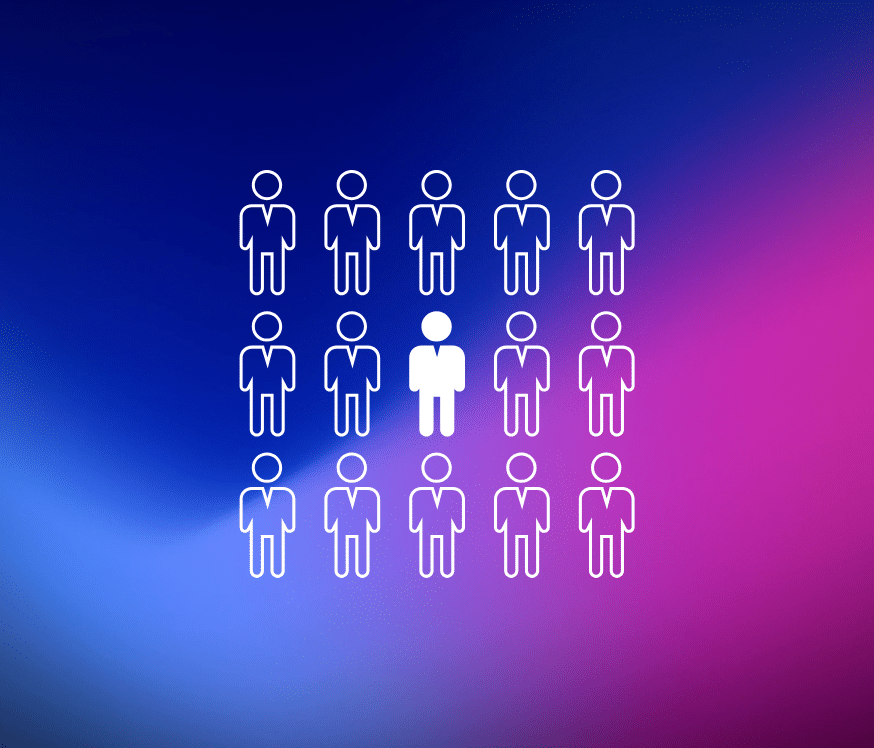
AI made beautiful creative cheap and instant. It also made it interchangeable. Why sameness is the hidden tax of the AI creative boom, and how to win your distinctiveness back.
We solved the wrong bottleneck
Ask a room of marketers what generative AI fixed for them, and you’ll hear the same answer: speed. Briefs that took three weeks now take an afternoon. The problem is that everyone got the same superpower at the same time, and pointed it at the same playbooks.
The result is visible to anyone who scrolls. Feeds have developed a house style: the same soft-gradient backdrops, the same confident sans-serif overlays, the same too-perfect hands holding the product, the same upbeat synth-pop cut. It looks polished. It also looks like everyone else. And marketers know it. In Smartly’s 2026 trends survey of 450 marketing leaders, three in four said they worry AI-generated creative is making brands look and sound the same. Eighty-six percent went further: they’ve already seen AI output that resembles a competitor’s work.
Read that again. A majority of the industry is describing their own feeds, and they’re uneasy about it. The thing AI made easy was production. The thing it quietly made scarce was difference.
By the numbers: 3 in 4 marketers worry AI creative is making brands look and sound the same · 86% have already seen AI output that resembles a competitor’s · 95% are already working with generative AI in creative production.
Generative models pull everyone toward the median
This isn’t a failure of the tools. It’s the physics of them. A generative model is, in essence, a very sophisticated average of everything it has seen. Ask it for “a high-performing skincare ad” and it returns the consensus of a million high-performing skincare ads. Feed it the same best-practice brief that your competitor fed it, with the same reference images pulled from the same trend decks, and you will both arrive at roughly the same place. Faster.
Layer the platforms on top and the gravity gets stronger. Meta’s Advantage+, Google’s Performance Max and TikTok’s Smart Performance have all quietly commoditized targeting: the machine now finds the audience for you. That was supposed to free up creative. Instead, many teams responded by pumping the same templated output into the same automated pipes. Everyone optimizing toward the same signals, with the same tools, produces convergence. The feed becomes a hall of mirrors.
Sameness is a performance problem, not just a brand one
It’s tempting to file “our ads look generic” under brand vanity. Don’t. Now that targeting is automated, creative is doing the heavy lifting on performance: Meta’s own research attributes 56% of ad performance variance to creative, up from 47% in 2023. Creative is no longer the garnish on the media plan. It is the media plan.
So follow the logic. If creative now decides most of your performance, and your creative has regressed to the same mean as everyone else’s, then you have handed away your single biggest lever. The algorithm has nothing distinctive to reward. Your CPMs rise in a feed of look-alikes, your hook earns a half-second less attention, and your “efficient” AI workflow quietly produces efficiently average results.
When every brand prompts its way to the same ad, distinctiveness stops being a brand luxury and becomes the cheapest performance lever you’re not pulling.
Distinctiveness, on purpose
The market is already leaning the other way, and you can feel it. Adobe’s 2026 creative read found audiences pulling toward the tactile, the analog and the unmistakably human (real textures, real people, real stories) precisely because the feed is flooding with frictionless AI gloss. Raw, specific, idiosyncratic creative cuts through the smoothness. The brands winning right now look like themselves, not like the prompt.
But “just be different” is not a strategy. It’s a poster. Difference for its own sake is how you get weird-but-ineffective. What you actually need is to know which of your distinctive moves drive results and which are merely noise, so you can lean into the ones that are both yours and effective. That’s a measurement problem before it’s a creative one.
The sameness trap: Prompt the default tool with the category brief, ship the polished consensus, and let the platform optimize a look-alike against other look-alikes. Cheap, fast, forgettable.
The distinct path: Use AI for volume, then use evidence to find the hooks, framing and motion that are uniquely yours, and concentrate spend there before the feed regresses you to the mean.
Use AI for volume. Use intelligence for direction.
The answer was never to abandon AI: 95% of teams are already working with it, and that’s not reversing. The answer is to stop letting the tool choose the direction. Pair cheap, fast production with creative intelligence: a clear, data-grounded read on which signals move your audience, which patterns are converging toward the category average, and which variations deserve budget, ideally diagnosed before you spend, not after.
Concretely, that means three habits. First, generate widely but diagnose ruthlessly: treat AI output as raw material to be tested, not finished work to be shipped. Second, protect your distinctive assets (the specific hook style, color, voice or talent that the median ad can’t replicate) and brief the tools to amplify them, not sand them off. Third, optimize before you scale, so the generic variants get sharpened or cut early instead of quietly bleeding your CPMs. AI gives you a hundred ads in an afternoon. Intelligence tells you which three are worth the world seeing.
That read used to be a guess. It isn’t anymore. A creative optimization layer can now learn from your own past performance and from what the rest of your category is doing, so performance, media and creative finally work as one unit, speaking the same language instead of arguing past each other. That is the gap Alison.ai was built to close. It studies your creative against both your competitors and your own history, shows you exactly where its strengths and weaknesses are, and helps you improve it in the direction that’s already working, so your output keeps getting sharper and stays unmistakably yours instead of looking like everybody else’s.
The brands that win the next year won’t be the ones that adopted AI fastest. Nearly everyone did that. They’ll be the ones who used it to become more themselves instead of more like everyone else.
See where your creative is blending in, and where it isn’t. Book a demo for us to go over your creatives, surface their real strengths and weaknesses against your category, and show you where to push so they stay unmistakably yours.