The Ads That Won Messi’s Farewell Weren’t Selling Anything

Jul 23, 2026
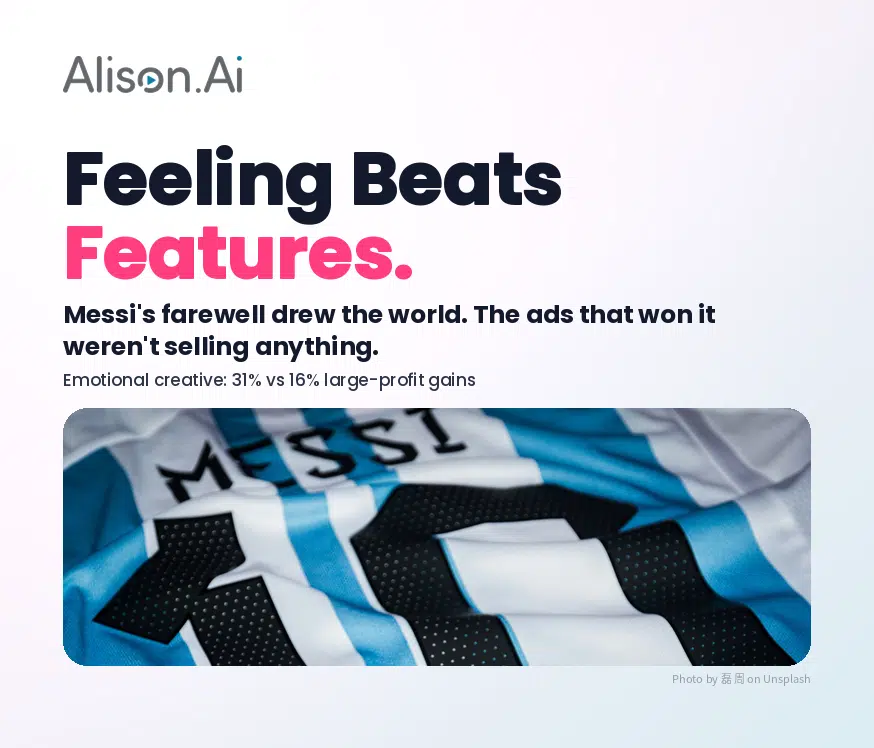
When a moment peaks on emotion, emotion-led creative beats product-led creative. Messi’s World Cup farewell was this year’s clearest proof: the ads people remembered leaned into nostalgia and feeling, not features. Decades of data agree, and reading whether your creative actually carries that feeling is exactly what Alison.ai is built to do.
Sunday’s final did not go Messi’s way. Argentina lost 1-0, and at 38, in what everyone understood to be his last World Cup, he had a quiet game. It did not matter to the billion-plus people watching. They were not there for a scoreline. They were there for a goodbye. That is what an emotional peak looks like: a moment where the feeling is the product, and everyone in the room already knows it.
Feeling travels. A spec sheet does not.
This is not sentiment, it is evidence. Analyzing nearly 1,000 campaigns in the IPA Databank, Les Binet and Peter Field found emotional campaigns were almost twice as likely to drive very large profit gains as rational, product-led ones, roughly 31 percent versus 16 percent, and they outperformed on sales, market share, pricing power, and loyalty. The reason is simple and human: people share what moves them, not what informs them.
So when a brand shows up at an emotional peak with a feature-led ad, it is not just a little off-key. It is spending premium money on the one kind of creative the moment is least likely to reward, and least likely to be passed on.
The scoreboard doesn’t lie
You could see it on the tournament’s own tape. LEGO’s spot of Messi, Ronaldo, Mbappe, and Vinicius Junior building a toy World Cup trophy, pure camaraderie with nothing to sell, racked up 314 million views across the players’ channels. Adidas revived its beloved Jose+10 idea in a Messi-fronted film built on 20 years of emotional equity, then rode the tournament to roughly $292 million in World Cup product sales before a ball was even kicked. Nike’s story-led work scored about 35 percent above the norm for attention on Fox.
Now the other half of the scoreboard. The ads that stacked celebrities with no story to hold them together got noticed, then forgotten. Coca-Cola showed the split inside its own campaign: the film that put the product front and center landed flat, while the one that pushed the product into the background and let the feeling lead traveled much further. As one review of the tournament’s advertising put it, fame comes from being noticed and growth comes from being remembered. A feature-led ad at an emotional peak buys the first and forfeits the second.
The assist before the goal
Here is the hard part. Emotion is the most powerful lever in creative and the easiest to misjudge. A team can feel sure an ad is moving and be wrong, and at a once-only moment there is no second attempt to find out.
That is the gap Alison.ai closes. Our Creative Genome reads the emotional signals in a piece of creative, and Preflight Plus scores it against the job you are actually asking it to do, so you know whether your ad carries feeling or only claims to, before you spend. You walk into the moment knowing your creative is built to be felt and shared, not just seen.
At the final whistle
Messi’s farewell will be remembered for how it felt, not for the final score. The brands that rose to it will be remembered the same way. Feeling is not the soft part of marketing. At moments like this, it is the whole game. If you think you’re ready to win it, book your demo today.